


Latin America and the Caribbean Needs New Diversification Strategies amid a Global Shift in the Rules of Trade
29 Jan 2026
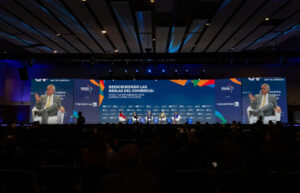
ECLAC’s Executive Secretary, José Manuel Salazar-Xirinachs, participated in the panel entitled “Rewriting the Rules of Trade: Challenges and Opportunities for Latin America and the Caribbean”, during the International Economic Forum Latin America and the Caribbean 2026 (photo: CAF).
Global Trade Disruptions Demand New Strategies
The Executive Secretary of the Economic Commission for Latin America and the Caribbean (ECLAC), José Manuel Salazar-Xirinachs, said today that given the current rupture to the international order and the shift in global trade rules, the region needs new strategies in order to diversify and reach agreements with other trade areas in the world.
The United Nations regional commission’s highest authority participated in the first day of the International Economic Forum Latin America and the Caribbean 2026: How to position the region on the global stage?, organized by CAF-Development Bank of Latin America and the Caribbean and the government of Panama, in Panama City.
José Manuel Salazar-Xirinachs spoke on a panel entitled Rewriting the Rules of Trade: Challenges and Opportunities for Latin America and the Caribbean, along with Amparo López Senovilla, Secretary of State for Trade of Spain; Gonzalo Gutiérrez, Secretary General of the Andean Community; and Víctor Orlando Bisonó, Minister of Industry, Trade and MSMEs of the Dominican Republic (2020–2026) and current Minister of Housing, Habitat and Buildings. The segment was moderated by Gabriela Frías, journalist and presenter for news channel CNN en Español.
Diversification Is Central to Trade Resilience
“We need to have a more diversified portfolio, both in terms of export products as well as export destinations and markets and trading partners,” Salazar-Xirinachs emphasized.
He noted that, as ECLAC has been saying in recent months, Latin America and the Caribbean must escape the trap of low capacity for growth in which it is caught.
“That requires strategies in specific sectors; how to take advantage of strategic minerals, of certain strategic sectors: medical devices, modern services, etc. The new geopolitical conversation, which is a rivalry for industrial and technological leadership, is largely a conversation about strategies in specific sectors,” he stated.
With regard to international trade negotiations, ECLAC’s Executive Secretary stressed that the great benefit of multilateral rules is that, to the extent that the major powers submit to the rules of trade, certainty prevails.
“Everything multilateral is desirable for medium-sized countries and even for middle powers. Integration is fundamental. We don’t have to look to Asia or Europe alone. We are sitting in a market of 660 million people (in our region); that is a gigantic potential driver of growth,” he indicated.
Regional Integration Offers Untapped Potential
He added that while many major powers are engaged now in a game of “weaponized interdependence” – which includes tariffs, interventions, penalties in financial matters, in other words all those economic mechanisms in which unilateral measures are used – Latin America and the Caribbean is best served by deepening its integration, which is critical.
He recalled that South America’s intraregional trade is around 13-14% of that subregion’s total trade. The comparable figure in Central America is 25%, whereas Mexico exports more than 80% to the United States, which entails another economic reality.
José Manuel Salazar-Xirinachs also specified that the region must not only focus on its assets related to natural resources or nature – such as strategic minerals, agriculture, overall biodiversity, tourism – but also on the existing productive capacities that the region has built, such as clusters of medical devices, the aeronautical and software industries, ecosystems of technological start-ups, etc.
“There is a structure of production and technological knowledge in many Latin American countries that was not provided by nature or the subsoil. We have many lessons from countries that were able to build more of those productive capacities,” he insisted.
“But none of this is going to happen spontaneously. Strategies are needed. Some are national strategies and others will require collaboration between different governments and the private sector. The diagnosis is clear. The issue is ‘how’ to do it and having the political will to carry it out,” he concluded.